Nuva team
AI-Generated Models vs. Licensed Digital Likeness: Which Fits Your Campaign?
Compare fictional AI models and licensed real-person likenesses for advertising and fashion. Understand casting, permissions, and production trade-offs.
Searching for “AI models for advertising” can lead to very different products. One tool might create an invented face. Another workflow might generate imagery using the authorized likeness of a real person.
Both can involve AI. The difference is whether a specific human identity is part of the creative—and what permission accompanies it.
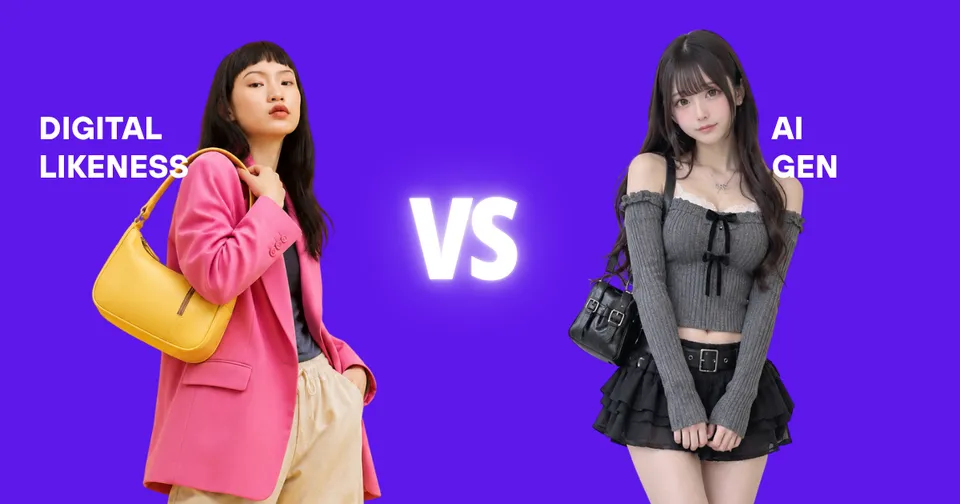
A fictional AI model is an invented character. A licensed digital likeness represents a real person under an agreement defining the permitted use. Choose between them by looking at your campaign's casting needs, rights requirements, and production workflow.
What is a fictional AI model?
In this article, a fictional AI model means an AI-created human character that is not intended to represent a specific real individual. A brand might use this approach to develop an invented visual persona or explore a campaign concept.
The practical questions include whether the tool permits your intended commercial use, whether the output creates unwanted resemblance, and whether it meets the requirements of the publishing channel.
An invented face should not be treated as an automatic answer to every rights or advertising question. The rest of the image may still involve products, logos, source material, or claims that need review.
What is a licensed digital likeness?
A licensed digital likeness uses the appearance of an identifiable real person with agreed permission. AI may place that person in a new scene or create a depiction that was not captured in a conventional shoot.
The value begins with casting: you are choosing a particular person's presence. The agreement then defines the context in which that appearance can be represented.
Nuva is being built for this approach, connecting producers with real talent through consent, defined commercial permissions, and traceable licensing records.
Compare the two approaches
| Decision | Fictional AI model | Licensed real-person likeness |
|---|---|---|
| Identity | An invented character | An identifiable person |
| Casting | Develop or select a synthetic appearance | Select talent whose look and permissions fit the brief |
| Core permissions review | Tool terms, inputs, output, resemblance, and publishing context | Those workflow checks plus the person's agreed likeness scope |
| Creative changes | Constrained by tools, policies, and other applicable rights | Also constrained by the talent's agreed depiction and boundaries |
| Compensation | Tool and production costs | Talent licensing fees plus applicable production costs |
| Continuity | Depends on the generation workflow | Also depends on the generation workflow; a license does not ensure visual consistency |
| Best suited to | Projects intentionally built around a fictional identity | Projects where the presence of a specific real person matters |
When licensed real talent may fit better
Consider licensed digital likeness when your creative direction begins with a specific human presence: an expressive face, a distinctive character, or talent suited to the audience and story.
A fashion campaign might want the same consenting person across a planned set of visuals. A regional brand might want to cast real Thai or Asian talent. A short film might need a coherent cast with documented permissions.
These are casting decisions as much as technology decisions. Licensing gives the team a defined basis for representing that person; it does not guarantee audience response or campaign performance.
When a fictional character may fit
An invented identity may fit a deliberately imaginary brand world or a concept that does not depend on a real person's appearance.
Be clear about what the audience is seeing. A fictional character should not be casually presented as an actual customer with a personal product experience. Similarly, licensing a real person's face does not automatically authorize every testimonial or endorsement script.
Budget for the complete workflow
Avoid comparing only a software subscription with a talent fee. Both approaches can require creative development, generation, retouching, quality review, and revisions.
For licensed likeness, add the relevant licensing and asset-preparation costs. For either approach, assess whether the tool can maintain the required visual consistency and accurately represent the product.
For clothing and e-commerce work, review garment construction, fit, color, logos, hands, and body proportions. Permission to use a face does not establish that the resulting product image is accurate.
[insert image: Annotated fashion-image review with callouts for garment details, face consistency, hands, and product color. Label the campaign as illustrative. Suggested alt text: Quality checks for AI fashion imagery before publication.]
Frequently asked questions
Is licensed digital likeness the same as an influencer campaign?
No. A likeness license may cover appearance in the brand's content. Posting to the talent's own channels or accessing their audience requires a separate agreed scope.
Is one approach always cheaper?
No reliable comparison can be made without the brief. Output quality, revisions, rights, duration, and production requirements all affect cost.
Does Nuva sell fictional AI people?
Nuva's core focus is licensed human likeness: real talent participating through defined permissions. Its intended marketplace supports discovery and licensing rather than serving as a general AI image generator.
Choose the identity your campaign needs
If a real person's presence is central to the idea, start with the talent and permissions before building the production around a tool.
Nuva is now live. Start licensing verified talent for your next project.
Next: How to license a real person's likeness for AI advertising.
If a real person's presence is central to the idea, start with the talent and permissions before building the production around a tool.